

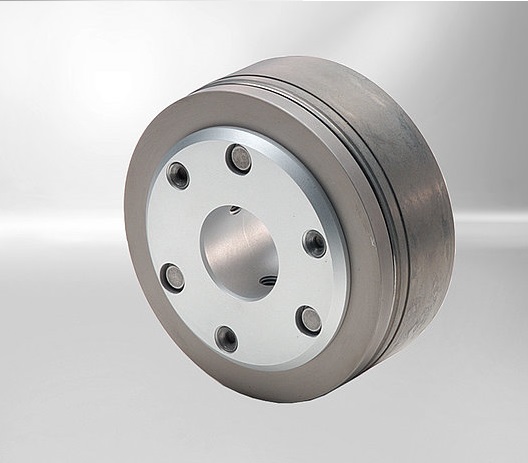
Brakes BINDER 86 61121K00
Permanent Magnet Brakes BINDER Higher Torque – Type 86
86 61102K00
86 61103K00
86 61104K00
86 61105K00
86 61106K00
86 61107K00
86 61108K00
86 61109K00
86 61110K00
86 61111K00
86 61114K00
86 61116K00
86 61121K00
86 61102P00
86 61103P00
86 61104P00
86 61105P00
86 61106P00
86 61107P00
86 61108P00
86 61109P00
86 61110P00
86 61111P00
86 61114P00
86 61116P00
86 61121P00
Our High Torque Line
Functionality
This product combines the well-known properties of permanent magnet brakes – Due to a re-design of the magnetic circuit, it features further advantages such as a higher torque at identical size and power consumption, high torque constancy throughout the complete service life and an extended temperature range.
Operating principle
The High Torque brake is designed to operate dry. The force generated by a permanent magnetic field is utilised to produce the braking effect. To neutralise the braking action, the magnetic flux of the permanent magnets is cancelled by an alternate electromagnetic field (electromagnetically released system). The zero backlash connection between the armature and flange hub ensures zero backlash transmission of the brake torque to the machine shaft (e.g. motor shaft) and reliable release of the High Torque brake with zero residual torque. Thanks to these features, High Torque brakes are ideal for servo motor applications.
Brake design
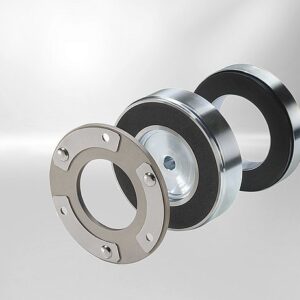
The firmly fitted field coil is installed between the housing and flange of the High Torque brake. The flying leads required to connect the field coil exit at defined positions on the brake. The permanent magnets installed in axial direction between the housing and flange generate the magnetic field required to produce the braking action. The armature is connected with the flange hub by means of segmental springs and rivet fasteners to establish an axially movable, torsion-proof and friction-free connection. This ensures zero residual torque during horizontal or vertical brake operation. The rated air gap ‘s’ between the armature and housing of the High Torque brake is automatically adjusted during brake mounting (e.g. through mounting tolerances). The flange hub is attached to the machine shaft (e.g. motor shaft) in such a way that a torsion-proof and axially fixed connection is achieved. The permanent magnetic field attracts and pulls the armature in frictional contact with the housing and flange. The resulting friction force generates the brake torque. When DC voltage is applied to the field coil of the High Torque brake, the alternate electromagnetic field offsets the force exerted on the armature by the permanent magnetic field and the brake is released as a result of the spring force. Except for the minimal force exerted by the segmental springs, the shaft to be braked is not exposed to any other axial force.
Technical Details
| Description | Value |
|---|---|
| Nominal torque range | 0.1 Nm – 280 Nm |
| Voltage | DC 24 V |
| Protection class | IP 00 |
| Temperature range | -15 °C to +120 °C, optional -40 °C |


Reviews
There are no reviews yet.